

.png)
How to build a Scope 3 program that’s defensible, decision-ready, and built to scale
Scope 3 emissions are often the largest and most complex part of a company's carbon footprint — spanning 15 categories of indirect emissions across upstream and downstream supply chains.
Getting Scope 3 right is not just a compliance exercise. Done well, it surfaces cost reduction opportunities, flags supply chain risk, strengthens supplier accountability, and supports better procurement decisions. The data becomes a strategic asset, not just a reporting line item.
Here is how to build a Scope 3 program that delivers that value.
Step 1: Prioritize Categories, Not Everything at Once
The GHG Protocol defines 15 Scope 3 categories, but for most companies, 2–4 categories account for the majority of their emissions footprint.
For PE firms and impact investors, the highest-priority categories are typically:
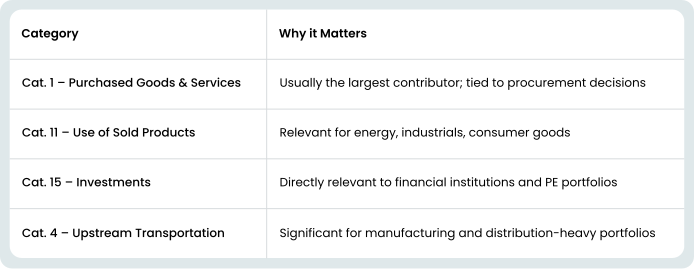
Step 2: Use the Data You Already Have
A common misconception is that Scope 3 measurement requires primary supplier data from day one. It does not.
Three tiers of data quality exist. Use the best available:
- Supplier-specific data: actual emissions reported by suppliers (ideal, but rare initially)
- Activity-based data: your own spend, volume, or usage data combined with published emission factors (DEFRA, EPA, ecoinvent)
- Spend-based data: financial spend mapped to EEIO (environmentally extended input-output) emission factors (lowest precision, but sufficient for screening)
A credible Scope 3 program documents which tier was used for each category and why — that transparency is what makes it defensible to auditors and investors.
Step 3: Connect Measurement to Decisions
Measurement without application is a compliance cost. Measurement tied to decisions becomes an operational asset.
Here are four ways a credible Scope 3 inventory creates value beyond reporting:
- Cost reduction proxy: High-emission supply chain activities often correlate with inefficiency (e.g. excess transportation, energy-intensive processing, over-specification). Emission hotspots frequently map to cost reduction opportunities.
- Supply chain risk identification: Suppliers with high Scope 3 exposure to carbon-intensive inputs usually indicate regulatory and transition risk. Identifying concentration in high-risk categories before it becomes a financial event is protecting value.
- Procurement leverage: Supplier scorecards that include emissions performance create a basis for preferential sourcing, contract incentives, and evidence-based supplier development — not just reporting checkboxes.
- Portfolio-level benchmarking (for investors): For PE firms and impact investors, Scope 3 Category 15 (investments) allows benchmarking portfolio company emissions intensity against sector peers to inform hold, exit, and value creation strategies.
Step 4: Build a Process You Can Repeat
One-off measurement exercises produce reports. Repeatable processes produce improvement.
Your Scope 3 program should establish:
- A defined baseline year — typically the first year with reasonably complete data
- A data collection workflow that does not require heroic effort each cycle
- Version-controlled calculations so year-over-year changes are auditable
- A supplier engagement pathway to progressively replace spend-based estimates with higher-quality data
This is where many companies stall. They complete a measurement but have no mechanism to improve data quality or track reduction progress. Design for repeatability from the start.
What "Defensible" Actually Means
A defensible Scope 3 inventory is not a perfect one. It is one that:
- Follows an established methodology (GHG Protocol Corporate Value Chain Standard)
- Documents assumptions and data sources transparently
- Distinguishes between what was measured and what was estimated
- Is consistent year-over-year so trends are meaningful
- Has been reviewed by someone independent of the team that built it
Auditors, LPs, and regulators are not looking for zero uncertainty. They are looking for methodology rigor and honest disclosure of limitations.
How Tablecloth Supports
If you're managing multiple portfolio companies with inconsistent data sources and no standardized process, that stall can be expensive — in time, credibility, and rework.
Tablecloth replaces the ad hoc approach with a structured, auditable process that doesn't require adding headcount. Data ingestion, emission factor libraries, supplier engagement workflows, and version-controlled documentation are built in so your team spends time on decisions, not data wrangling.
The result is a Scope 3 program that holds up when LPs ask hard questions and gets more useful every reporting cycle.


