


For multi-site operators, emissions reporting rarely begins with a dedicated system. It begins with the tools that already exist: utility bills, invoices, a shared folder, and spreadsheets owned by people who know their sites.
That approach can work when operations are small. The pressure changes when emissions data becomes a compliance input that requires standardization and rigor. California’s SB 253 raises that pressure for many companies in 2026: SB 253 sets a first-year Scope 1 & 2 reporting deadline of Aug 10, 2026 for covered entities.
In plain terms:
- Scope 1 covers direct emissions from sources a company controls (for many operators, that includes on-site fuel use and certain refrigerant-related emissions).
- Scope 2 covers indirect emissions from purchased energy (most commonly electricity), and it’s often reported in both location-based and market-based methods.
The baseline
One company we worked with recently had built a practical baseline in Excel. Local teams maintained site-level files, and a central owner consolidated everything into an aggregated workbook used for reporting. The workflow quickly became unwieldy, spanning roughly 90 spreadsheets across multiple location-based entities.
They began piecemeal data collection around 2022. Even so, the routine fit how teams operated and produced numbers they were comfortable sharing. As requirements tightened and more internal stakeholders relied on the same dataset, the team wanted to validate that their Scope 1 and 2 numbers would hold up.
What the spreadsheets were hiding
In a workflow spread across dozens of files, accuracy depends on small details staying aligned over time: formulas, units, factor vintages, and methodology choices. A review surfaced issues that commonly show up in multi-site spreadsheet systems:
- A formula error that applied an extra multiplication factor
- Potential unit conversion issues tied to fuel emissions factors (e.g., natural gas, heating oil) large enough to materially change Scope 1
- Older Scope 2 factor datasets used even though updates were available
- Inconsistent handling of location-based vs. market-based calculations, including renewable energy treatment that should only affect market-based results
The team had been confident in the workbooks. The discrepancies were unexpected, and they chose to correct both current and historical outputs to protect year-over-year comparisons.
When the numbers moved, the risk got real
At scale, small spreadsheet inconsistencies can shift totals and make reporting cycles harder to close. In this case, the gap between reported and corrected results was material:
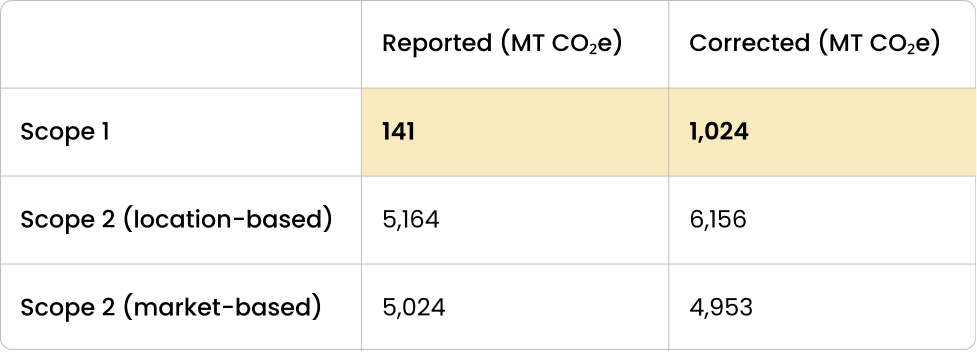
These were the outputs being used for reporting. With SB 253’s deadline approaching for covered entities, the team wanted a workflow that reduced errors introduced through copied formulas, inconsistent inputs, or outdated factor datasets.
How they strengthened the workflow
The company kept local ownership of data entry and added guardrails designed for multi-site reporting. With Tablecloth.io, they standardized templates across sites, added validation to catch formula/unit issues earlier, made location-based vs. market-based Scope 2 treatment explicit, and built rollups with traceable logic for review.
After corrections and standardization, the team could see what drove the totals and what changed between versions. Reporting became easier to review and explain, and year-over-year comparisons depended less on manual reconciliation.
That shift also changed who could use the data: instead of passing spreadsheets around, the company could give relevant stakeholders visibility into the verified outputs in one place—whether that meant internal teams supporting reporting, or investor-facing teams preparing updates. With the baseline verified, Throughlines helped them move from reporting to management, linking follow-on actions to the metrics and making progress easier to track over time.
Why it didn’t stop at emissions
Once the company had a repeatable collection workflow and traceability for emissions, they extended the same approach to other business-critical reporting—operational and portfolio data that also spans sites, changes over time, and needs consistent rollups for leadership and stakeholders.
What to do next
If you’re preparing for SB 253 (or if your Scope 1 and 2 process still runs through dozens of spreadsheets), Tablecloth.io can help you implement a repeatable, reviewable reporting workflow without taking data ownership away from site teams. Reach out to see how Tablecloth.io supports multi-site collection, validation, and rollups for emissions and other business reporting.


